 listicle
Eco-Friendly Alternatives to Disposable Coffee Pods
Table of Contents
- Why Disposable Coffee Pods Create an Environmental Problem
- Brew Bag Coffee: A Compostable Alternative
- Reusable K-Cup Filters and Refillable Capsule Systems
- Pour Over Brewing with Reusable Coffee Filters
- French Press: Zero Waste, Full Flavor
- How to Recycle Coffee Pods Responsibly
- Lifecycle Assessment: Environmental Impact Comparison
- Brewing Quality: Sustainable Methods vs. Single-Use Pods
- Maintenance and Cleaning Guide for Reusable Systems
- Reducing Your Coffee Carbon Footprint
- Making the Switch: Practical Next Steps
- Frequently Asked Questions
Last Updated: September 25, 2026
Why Disposable Coffee Pods Create an Environmental Problem
Single-use coffee pods have become a convenience staple, but their environmental cost is substantial. Billions of pods end up in landfills annually, taking decades to decompose. Most traditional pods combine plastic, aluminum, and coffee grounds in ways that make them difficult to recycle or compost. This creates a genuine problem for eco-conscious consumers who want their morning coffee without the guilt.
The core issue: pods were designed for convenience, not sustainability. Manufacturers optimized for speed over environmental responsibility, creating a product that solves a consumer problem while generating an ecological one.
Happy Bear Coffee offers eco friendly alternatives to disposable coffee pods, providing solutions that maintain quality and convenience. This guide explores practical ways to break free from single-use pods.
Brew Bag Coffee: A Compostable Alternative
Brew bag coffee represents the simplest shift from disposable pods. These single-serve packets contain pre-portioned, pre-ground coffee wrapped in a compostable filter. You simply steep them in hot water like tea, no machine, no cleanup beyond emptying the grounds.
Happy Bear Coffee's POURTA brew bags deliver a richer, more complete extraction than traditional single-serve options through advanced filter design that optimizes water flow. Each bag contains precision-ground, ethically sourced beans roasted to order, with compostable materials.
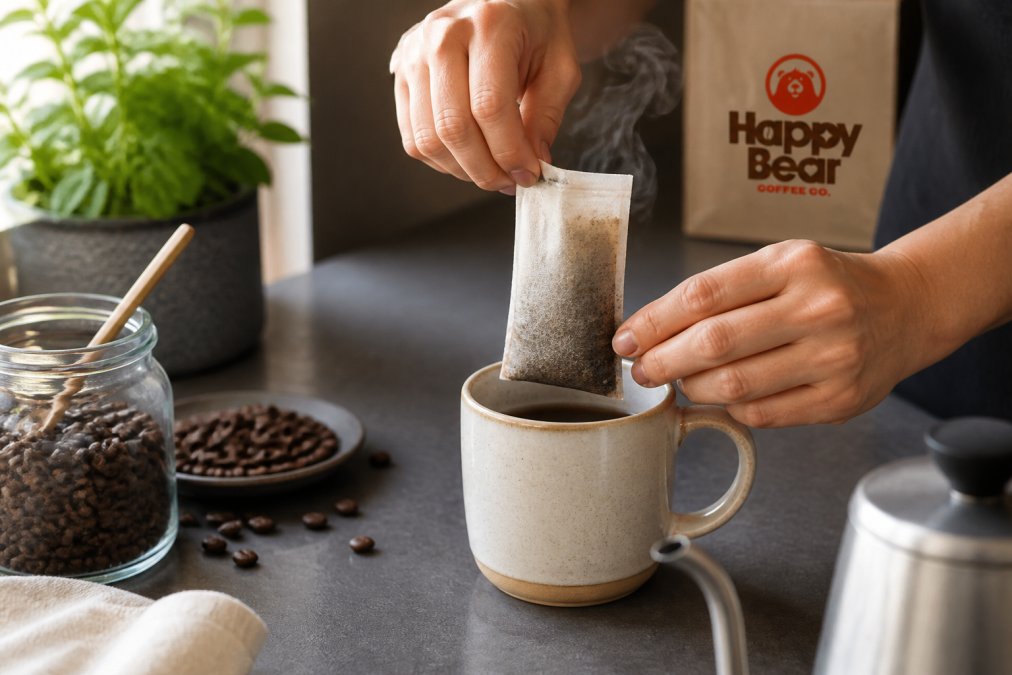
Full immersion brewing extracts more flavor compounds than pod machines' limited contact time, delivering a stronger cup without machine dependency. Just hot water and a mug.
Happy Bear Coffee offers multiple roast profiles from Hunny's Den Blend to Hibernation Dark Roast. The Variety Pack of 8 ($20) lets you sample the range. Individual brew bags cost $2.79 each, delivering superior flavor and zero plastic waste.

Brew bags work everywhere, kitchen, office, camping, travel, with no electricity required. This portability makes them the fastest-growing eco friendly alternative to disposable coffee pods for quality-focused consumers.
Reusable K-Cup Filters and Refillable Capsule Systems
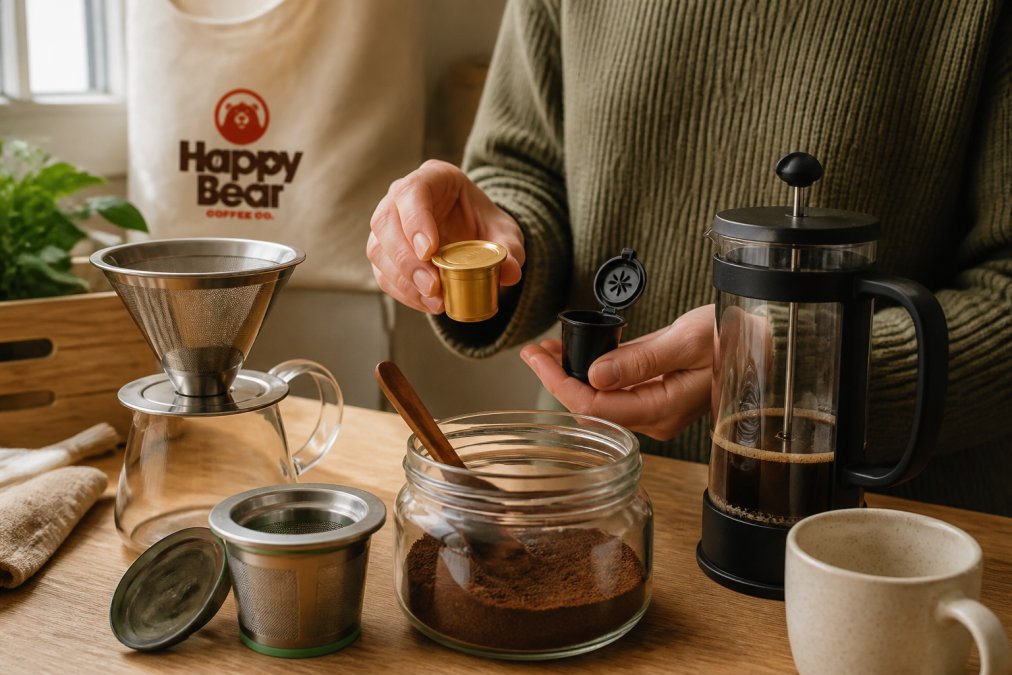
If you already own a pod machine, reusable K-Cup filters eliminate the need to replace it. These mesh or cloth filters fit inside your existing brewer, letting you use your own ground coffee instead of disposable capsules. The setup takes seconds, fill the filter, snap it in, brew normally.
The environmental benefit is immediate. Instead of discarding a pod after one use, you rinse the filter, dry it, and reuse it hundreds of times. Over a year, a single reusable filter prevents dozens of pods from entering landfills. This is one of the most direct ways to reduce your coffee carbon footprint without changing your morning routine.
Cloth filters like CoffeeSock (certified organic cotton) offer durability and performance lasting a year or more. Two-pack costs $22.
Reusable filters require grinding beans to proper consistency, immediate cleaning, and complete drying to prevent mold. For pod users, this feels like a step backward; for hands-on brewers, it's a welcome return to control.
Refillable capsule systems use hard plastic or aluminum capsules filled with your own coffee, offering more consistency than manual filters. However, compatibility with specific brewers is critical before purchasing.
A filter used 300 times eliminates 300 pods from the waste stream. A filter sitting unused provides no benefit. Honest assessment of your habits matters.
Pour Over Brewing with Reusable Coffee Filters
Pour over brewing is the oldest method for a reason, it works. Hot water poured slowly through grounds extracts flavor through gravity and time. No electricity, no moving parts, no pods. Just water, grounds, and a filter.
Reusable pour over filters eliminate paper waste. Cotton filters absorb oils while letting acids pass, producing a clear, crisp cup with the flavor profile between paper and French press, rich without heaviness.
The Collapsible Pour Over itself weighs just 6.5 ounces and packs into a wax canvas bag, making it perfect for camping, travel, or anyone who wants to reduce their coffee footprint without sacrificing quality. The kit includes two reusable CoffeeSock filters and the stainless steel dripper for $50. Replacement filters cost $22 for a pair and last a year or longer.

Pour over requires attention to water temperature (slightly off-boil), grind size, and pouring speed. For ritual-focused brewers, this is a feature; for those wanting automation, it's friction.
The environmental advantage is substantial: no electricity, no disposable filters, no pods. Only used grounds remain, composting naturally. This approaches zero-waste coffee.
French Press: Zero Waste, Full Flavor
French press brewing is the gold standard for flavor extraction and environmental simplicity. Coarsely ground coffee steeps directly in hot water for four minutes, then a metal mesh plunger separates grounds from brewed coffee. The result is a full-bodied cup with all the natural oils and flavor compounds intact.
The environmental profile is perfect. No filters, no pods, no electricity. The only consumable is the coffee itself. Used grounds go directly into compost or yard waste. This is true zero-waste brewing.
The BruTrek French Press with Bru-Stop features double-walled, vacuum-sealed construction in 32 oz or 48 oz sizes. The Bru-Stop Plate prevents grounds in your cup. At $69, it's a long-term investment.
The Travel Coffee Press by OVRLNDR brews 24 oz with a sip-and-snap lid and vacuum-insulated design. At $58, it's ideal for camping or travel.
French press sediment is a matter of preference. If you prefer clarity, pour over or brew bags are better choices.

Cleaning is straightforward: empty grounds immediately, rinse, and dry. The mesh screen lasts indefinitely with normal care.
How to Recycle Coffee Pods Responsibly
Most municipal recycling programs don't accept pods because they jam sorting equipment. Industrial composting can process some compostable pods, but home composting doesn't reach required temperatures. Manufacturers' take-back programs exist but require effort and postage. Recycling pods is cumbersome, this is why eco friendly alternatives to disposable coffee pods exist. Shifting to reusable systems eliminates the recycling problem entirely.
Lifecycle Assessment: Environmental Impact Comparison
Understanding the full environmental impact of different brewing methods requires looking beyond immediate waste. Lifecycle assessment (LCA) examines raw material extraction, manufacturing, transportation, use, and end-of-life disposal. When you compare brewing methods using actual environmental metrics, the differences become stark.
Manufacturing Impact: The One-Time Cost
Disposable pods require continuous manufacturing for plastic/aluminum production, molding, packaging, and shipping. Reusable systems require manufacturing once. A stainless steel French press (1.5-2.5 kg CO₂ equivalent) breaks even on manufacturing emissions after roughly 25-40 uses compared to aluminum pods (0.05-0.08 kg CO₂ equivalent per pod), then provides decades of use.
Brew bags occupy a middle ground with manufacturing carbon footprint of 0.02-0.04 kg CO₂ equivalent per bag. Unlike disposable pods, the compostable filter returns to soil rather than persisting in landfills.
Water and Energy During Use
Water consumption is similar across methods (0.2-0.35 liters per cup). Energy consumption differs dramatically: pod machines use 0.15-0.25 kWh per cup; pour over and French press use 0.05-0.08 kWh per cup, a 60-70% reduction. Over ten years, one cup daily in a French press versus pod machine saves 370-620 kWh (roughly 110-185 kg CO₂ equivalent).
End-of-Life Disposal
Disposable pods persist in landfills for 150-500 years. Compostable pods require industrial composting (90-180 days); home composting doesn't reach required temperatures. Reusable systems generate no end-of-life waste beyond used grounds (compost in 2-6 months), with only the equipment itself recyclable after 10-20 years.
Total Environmental Cost Per Cup: A Comparison
When you combine manufacturing, use-phase energy, water, and end-of-life disposal, the total environmental cost per cup varies dramatically:
Variety Pack of 8 Single Serve Brew Bag →
- Disposable aluminum pods: 0.12-0.18 kg CO₂ equivalent per cup (including manufacturing, energy, and waste persistence)
- Disposable plastic pods: 0.15-0.25 kg CO₂ equivalent per cup (plastic degrades more slowly, increasing end-of-life impact)
- Compostable pods: 0.08-0.14 kg CO₂ equivalent per cup (lower end-of-life impact if actually composted industrially)
- Brew bags: 0.04-0.07 kg CO₂ equivalent per cup (lower manufacturing impact, compostable filter)
- Reusable filters with pod machine: 0.06-0.10 kg CO₂ equivalent per cup (amortized manufacturing plus machine energy)
- Pour over with reusable filter: 0.02-0.04 kg CO₂ equivalent per cup (minimal manufacturing amortization, low energy)
- French press: 0.02-0.04 kg CO₂ equivalent per cup (minimal manufacturing amortization, low energy)
After 100 cups, a French press has generated 2-4 kg CO₂ equivalent total. A person using disposable pods for the same 100 cups generates 12-25 kg CO₂ equivalent. Over one year (365 cups), the difference is 8.7-13.1 kg CO₂ equivalent, equivalent to driving a gasoline car 22-33 miles.
The Consistency Assumption
This analysis assumes consistent use. A reusable filter sitting unused provides no benefit. The best system is the one you'll actually use. Honest assessment of your habits matters more than theoretical environmental advantage.
Brewing Quality: Sustainable Methods vs. Single-Use Pods
Many eco friendly alternatives to disposable coffee pods can produce superior flavor to single-use pods. Pod machines optimize for speed, not flavor, limiting extraction time. Full immersion methods (French press, brew bags, reusable filters) allow longer water-ground contact, pulling more flavor compounds.
Pour over produces a balanced cup with controlled water contact and less sediment than French press. High-quality, freshly roasted beans matter more than brewing method. Switching from pods to sustainable methods can reduce environmental impact.
| Brewing Method | Flavor Profile | Environmental Impact | Ease of Use | Equipment Cost |
|---|---|---|---|---|
| Disposable Pods | Adequate, consistent | High (continuous waste) | Very easy | Low upfront, high ongoing |
| Brew Bags | Rich, full-bodied | Low (compostable) | Very easy | Moderate per use |
| Reusable Filters | Clean, balanced | Low (reusable) | Moderate | Low upfront |
| Pour Over | Clean, bright | Very low (no waste) | Moderate | Low to moderate |
| French Press | Full-bodied, rich | Very low (no waste) | Moderate | Moderate |
Maintenance and Cleaning Guide for Reusable Systems
Proper maintenance extends the life of reusable brewing equipment and ensures consistent quality. Neglect leads to mineral buildup, mold growth, and degraded flavor. Understanding why these problems occur helps you prevent them before they damage your equipment.
Why Mold and Mineral Buildup Occur
Mold grows in reusable filters and equipment because they retain moisture and organic material (coffee residue) in warm environments. Coffee contains sugars and proteins that feed mold spores. If a filter dries incompletely or is stored in a humid location, mold colonizes within 24-48 hours. Mineral buildup occurs because tap water contains dissolved minerals (calcium and magnesium). When water evaporates or sits in equipment, these minerals precipitate and accumulate as a white or tan crusty deposit. Hard water (over 120 mg/L of dissolved minerals) accelerates this process significantly.
For Reusable Filters (Cloth and Mesh)
Immediate post-brew cleaning: Empty grounds immediately while wet. Rinse thoroughly under running water, rubbing gently to dislodge particles. Use fingers or soft brush to work grounds out of mesh or cloth weave, paying special attention to edges. This 30-60 second step prevents grounds from hardening.
Drying and storage: Hang cloth filters in a well-ventilated area to dry completely before storage. Air circulation is critical, mold thrives in still, humid environments. Never store wet or damp filters in a closed container, drawer, or cabinet. If you live in a humid climate, consider hanging filters near a window or using a small fan to accelerate drying. Completely dry filters should be stored in a breathable container (paper bag, cloth pouch) in a cool, dry location. Inspect monthly for discoloration (dark spots or streaks) or odors indicating mold.
Mold treatment: If mold appears on a cloth filter, soak in a solution of equal parts white vinegar and water for 30 minutes. The acidity kills mold spores and prevents regrowth. After soaking, rinse thoroughly under running water and hang to dry completely. If mold returns repeatedly, the filter has likely degraded beyond effective use and should be replaced. Cloth filters typically last 12-18 months with proper care before fibers break down and become ineffective at filtering.
Mineral deposit removal: If your tap water is hard, mineral deposits accumulate on cloth filters as a white or tan film. Soak the filter in white vinegar (undiluted) for 15-20 minutes to dissolve deposits. Rinse thoroughly with fresh water. For mesh filters, use a soft brush to gently scrub away deposits while soaking. Do this monthly if you have hard water, quarterly if you have soft water.
For Pour Over Equipment (Ceramic, Glass, or Plastic Dripper)
Immediate post-brew cleaning: Rinse the dripper immediately after brewing while grounds are still wet. Use a brush to clean the interior ridges and spiral channels where coffee oils accumulate. These oils oxidize over time and create a rancid taste in subsequent brews. Pay special attention to the bottom cone where grounds settle. A small bottle brush or old toothbrush works well for this.
Drying: Dry completely before storing. Moisture trapped in the dripper's crevices promotes mold growth. Stand the dripper upside down on a clean cloth to allow air circulation through the drainage hole.
Mineral buildup prevention: Monthly, soak the dripper in hot water with white vinegar (1:1 ratio) for 20-30 minutes to dissolve mineral deposits. These deposits reduce water flow through the dripper, slowing extraction and producing under-extracted, sour coffee. After vinegar soaking, rinse thoroughly with fresh water multiple times to remove all vinegar residue, which can affect taste.
Ceramic vs. plastic considerations: Ceramic drippers are more durable and don't absorb odors or stains. Plastic drippers are lighter and more portable but can absorb coffee oils and develop permanent discoloration. If using a plastic dripper, soak in vinegar solution more frequently (every 2-3 weeks) to prevent oil buildup.
For French Press (Glass, Stainless Steel, or Ceramic)
Immediate post-brew cleaning: Empty grounds immediately while they're still wet. Disassemble the plunger mechanism completely, separate the metal mesh screen, the rubber gasket, and the metal rod. Rinse all components thoroughly under running water. The mesh screen requires special attention: use a small brush or old toothbrush to clean both sides, working perpendicular to the mesh weave to dislodge trapped grounds. Mineral buildup on the mesh screen reduces water flow and extraction quality, producing weak, under-extracted coffee.
Gasket and rod maintenance: The rubber gasket can accumulate coffee oils and mineral deposits. Rinse thoroughly and inspect for cracks or hardening. If the gasket becomes brittle or cracked, replace it, a damaged gasket allows grounds to escape into your cup. Replacement gaskets typically cost $5-12 and are available from the manufacturer or online retailers. The metal rod should be wiped clean and dried to prevent rust (for steel rods) or corrosion.
Mineral buildup treatment: Soak the entire disassembled French press in hot water with white vinegar (1:1 ratio) for 30-45 minutes. This dissolves mineral deposits from hard water that accumulate on the mesh screen and glass or steel body. After soaking, use a brush to gently scrub the mesh screen. Rinse all components thoroughly with fresh water multiple times.
Glass vs. stainless steel considerations: Glass French presses are easier to inspect for cleanliness and mineral buildup, but they're fragile and can break if dropped. Stainless steel French presses are durable and insulating (they keep coffee hot longer), but mineral deposits are harder to see. If using stainless steel, soak more frequently (every 2-3 weeks with hard water) to prevent hidden mineral accumulation.
Storage: Reassemble only after all components are completely dry. Store with the plunger in the raised position (not pressed down), as pressing it down while dry can damage the gasket. Store in a dry location away from humidity.
General Guidelines for All Equipment
Water quality matters: Use filtered water if your tap water is hard (over 120 mg/L of dissolved minerals). Mineral deposits accumulate faster in hard water, requiring more frequent cleaning. A simple pitcher filter or faucet-mounted filter costs $20-40 and dramatically reduces maintenance burden. If you can't filter your water, increase vinegar soaking frequency to every 1-2 weeks.
Timing is critical: Clean equipment immediately after use. Dried coffee is exponentially harder to remove than wet coffee. Grounds that dry on a mesh screen can take 10-15 minutes of soaking to remove, while wet grounds rinse away in 30 seconds. This single habit, cleaning immediately, prevents 90% of maintenance problems.
Storage environment: Store equipment in a dry location. Never store with grounds, moisture, or residual coffee inside. Humidity and organic material create ideal conditions for mold. If you live in a humid climate, consider storing equipment in a cabinet with a small silica gel packet to absorb moisture.
Replacement schedules: Cloth filters degrade gradually and lose effectiveness after 12-18 months of regular use.
Reducing Your Coffee Carbon Footprint
Environmental impact extends beyond brewing method to coffee sourcing, transportation, and consumption patterns.
Making the Switch: Practical Next Steps
Switching from disposable pods to eco friendly alternatives to disposable coffee pods doesn't require abandoning your pod machine or committing to a complete overhaul. Most transitions happen gradually.
Frequently Asked Questions
What is the most environmentally friendly coffee pod alternative?
Brew bags made from compostable materials offer one of the most eco-friendly single-serve options. They eliminate plastic waste, deliver full flavor extraction comparable to traditional brewing, and break down in industrial composting facilities. Reusable pour over systems and French presses are equally sustainable long-term options, with zero ongoing waste once purchased.
How do reusable k-cup filters compare to disposable pods?
Reusable k-cup filters eliminate the need for single-use plastic capsules, reducing landfill waste significantly. They allow you to use your own ground coffee, giving you control over quality and sourcing. While they require regular cleaning and drying, they pay for themselves within weeks and work with existing brewing machines, making them a practical transition for current pod users.
Do compostable coffee pods actually break down in home composting?
Most compostable coffee pods require industrial composting facilities to break down properly, as home compost temperatures typically don't reach the 140°F needed for full decomposition. Check the packaging for certification labels. Some brands label pods as 'home-compostable,' but these are rare. Always verify with your local composting program before adding pods to your bin.
How do I properly dispose of coffee pods if I can't compost them?
Check if your local recycling program accepts coffee pods, some municipalities have collection programs. If recycling isn't available, seal used pods in a compostable bag to contain grounds and dispose in regular trash. Never pour grounds directly into landfills or waterways. Contact your waste management provider to confirm what options exist in your area.