 ultimate-guide
How to Brew Specialty Coffee at Home: 2026 Guide
Table of Contents
- What You'll Need Before You Brew
- Best Coffee Brewing Methods for Beginners
- The Coffee to Water Ratio for Specialty Coffee
- The Importance of Burr Grinders for Coffee
- Step-by-Step: How to Brew Specialty Coffee at Home
- Water Quality and Mineral Content for Better Coffee
- Troubleshooting Common Brewing Mistakes
- How to Brew Specialty Coffee at Home on a Budget
- Frequently Asked Questions
Last Updated: September 19, 2026
What You'll Need Before You Brew
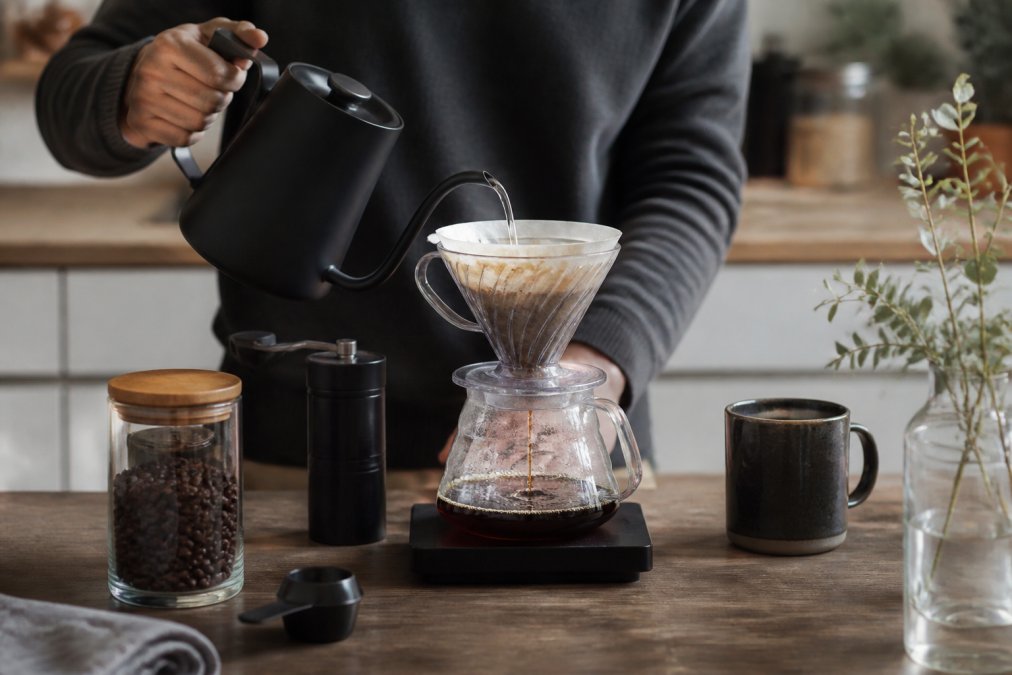
Brewing specialty coffee at home starts with four pieces of equipment: a burr grinder, a digital scale, a gooseneck kettle, and a brewing device. Everything else is optional. This guide from Happy Bear Coffee walks through how to brew specialty coffee at home without a closet full of abandoned gadgets.
The Specialty Coffee Association sets cupping standards that professional graders use to evaluate coffee.
Best Coffee Brewing Methods for Beginners
The two best brewing methods for beginners are pour-over and immersion brewing. Pour-over rewards attention and produces a clean, articulate cup. Immersion brewing forgives small mistakes and delivers consistent results with less technique.
Pour-Over: The Clearest Path to Flavor
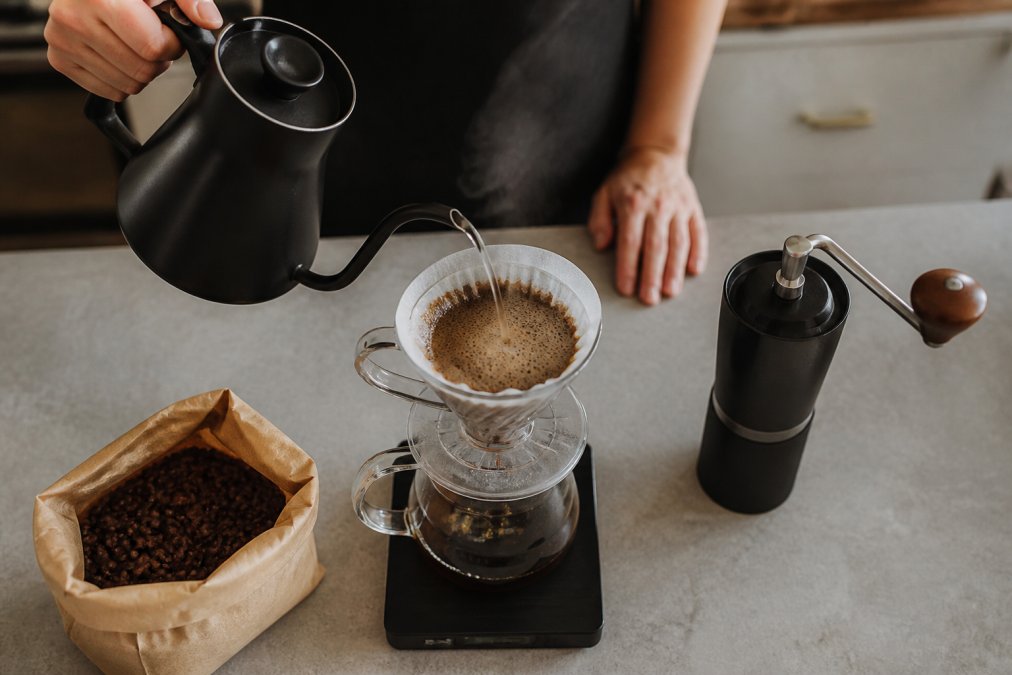
Pour-over brewing passes water through a bed of coffee in a paper filter, one controlled pour at a time. The result is a cup with high clarity: you taste the bean's origin, its acidity, its sweetness, without sediment muddying the picture.
Immersion Brewing: Forgiving and Consistent
Immersion brewing steeps coffee and water together before separating them. A French press is the classic example. Because the grounds are fully submerged, extraction is even and the method tolerates a slightly coarse or inconsistent grind better than pour-over does.
The Coffee to Water Ratio for Specialty Coffee
The coffee to water ratio for specialty coffee starts at 1:16 by weight, meaning one gram of coffee to sixteen grams of water. That's the baseline. Adjust from there.
| Preference | Ratio | Result |
|---|---|---|
| Lighter, tea-like | 1:17 | More acidity, less body |
| Balanced (start here) | 1:16 | Even sweetness and clarity |
| Richer, heavier | 1:15 | More body, less brightness |
The Importance of Burr Grinders for Coffee
The importance of burr grinders for coffee comes down to particle consistency. A burr grinder crushes beans between two abrasive surfaces set to a fixed gap, producing uniform particles measured in microns. A blade grinder chops randomly, leaving you with everything from powder to boulders in the same batch.
Step-by-Step: How to Brew Specialty Coffee at Home
Here's the full process, start to finish, using a pour-over as the reference method. Total time runs about eight minutes once your water is hot. The numbers below assume a 12-ounce cup: 22 grams of coffee to 355 grams of water, at a 1:16 ratio.
Step 1: Heat Your Water and Rinse the Filter
Heat water to between 195°F and 205°F. Water off a rolling boil is too hot and scorches the grounds. Let it rest a minute after boiling, or use a kettle with temperature control. For lighter roasts, aim toward the higher end of that range; for darker roasts, the lower end.
Step 2: Weigh and Grind Your Beans
Weigh your beans on a scale, then grind to a medium setting for pour-over or coarse for immersion. Grind right before brewing. Ground coffee begins losing aromatic compounds within minutes of exposure to air.
Step 3: Bloom, Pour, and Finish
Start your timer the moment water hits the grounds.
0:00-0:45, Bloom. Pour just enough water to saturate the grounds, about twice the coffee's weight (roughly 45 grams for a 22-gram dose). Wait 30 to 45 seconds. This is the bloom: trapped carbon dioxide escapes and the bed puffs up. Skipping it leaves gas in the way of water, which causes uneven extraction. Fresh beans will bloom dramatically; older beans barely at all, a useful freshness check.
Reading the Result
The total brew time is your feedback loop. Note the time, taste the cup, and adjust one variable at a time:
- Finished under 2:45, tastes sour or thin → grind finer.
- Finished over 3:45, tastes bitter or harsh → grind coarser.
- Finished in range but tastes weak → tighten the ratio toward 1:15.
- Finished in range but tastes too intense → loosen toward 1:17.
Water Quality and Mineral Content for Better Coffee
Water quality affects flavor more than most brewers realize. Coffee is roughly 98% water, so the minerals dissolved in it shape what you taste. This is the single biggest gap in most home-brewing guides, and it's where specialty coffee actually earns the name.
The Two Numbers That Matter
Total dissolved solids (TDS) measure everything dissolved in your water, but TDS alone tells you almost nothing useful. The two measurements that actually drive extraction are:
- Hardness, primarily calcium and magnesium ions. These are the minerals that bind to flavor compounds in the coffee grounds and pull them into solution. Magnesium in particular is more effective at extracting fruity and acidic notes than calcium.
- Alkalinity, primarily bicarbonate. Bicarbonate acts as a buffer. Too much of it neutralizes the acids that give coffee its brightness, and the cup tastes flat and chalky.
What Different Waters Actually Do
| Water profile | What happens in the cup |
|---|---|
| Distilled or reverse-osmosis (near-zero minerals) | Flat, hollow, sometimes papery. Nothing pulls the flavor out of the grounds. |
| Soft, low-alkalinity | Bright, sometimes sharp or thin. Good for light roasts, can taste sour on darker ones. |
| Balanced (SCA-range) | Sweet, articulate, origin character comes through. The target. |
| Hard, high-alkalinity | Muted acidity, chalky finish, scale builds up in your kettle and brewer. |
Practical Fixes at Home
You don't need a lab. Three approaches cover almost every kitchen:
- Taste your tap water first. If it tastes clean and neutral on its own, it will likely brew decent coffee. If it tastes strongly of chlorine, sulfur, or minerals, treat it.
- Carbon-filtered tap water (a pitcher filter or under-sink carbon block) removes chlorine and some organics without stripping minerals. This is the cheapest meaningful upgrade for most people.
- Remineralized water, start with distilled or reverse-osmosis water and add a brewing mineral packet or a homemade concentrate (commonly a mix of Epsom salt for magnesium and baking soda for bicarbonate). This gives you full control and is what many competition brewers use.
Why This Is a Specialty-Only Concern
Commodity coffee is roasted dark enough that the roast character dominates the cup, so water chemistry matters less. Specialty coffee is roasted lighter to preserve origin flavors, and those flavors are exactly what water minerals extract. That's why the same bean can taste vivid at one address and dull at another, and why fixing your water is often a bigger upgrade than buying a new grinder.
Troubleshooting Common Brewing Mistakes
Most bad cups trace to one of four problems. Here's how to diagnose them.
| Problem | Likely Cause | Fix |
|---|---|---|
| Sour, thin taste | Under-extraction | Grind finer or raise water temp |
| Bitter, harsh taste | Over-extraction | Grind coarser or shorten brew time |
| Weak but bitter | Uneven grind | Switch to a burr grinder |
| Watery, no sweetness | Wrong ratio | Weigh coffee and water, aim for 1:16 |
How to Brew Specialty Coffee at Home on a Budget
When you're ready to stock up, Happy Bear Coffee offers sustainably sourced single-origin beans, blends, flavored varieties, and decaf, plus a customizable bundle subscription so you can mix and match without committing to one roast. Every order supports the company's 5% donation program, and the team is a certified LGBT Business Enterprise and a Specialty Coffee Association member.
Frequently Asked Questions
What is the 15-15-15 rule for coffee?
The 15-15-15 rule is a simple guideline for brewing: use 15 grams of coffee, 15 times that amount in water (225 grams), and aim for a total brew time of around 15 minutes for cold brew. For hot pour-over, the same ratio applies but brew time is closer to 2-3 minutes. It's a starting point to help you remember a balanced coffee to water ratio for specialty coffee without needing a scale every time.
How is specialty coffee different from regular coffee?
Specialty coffee is graded by the Specialty Coffee Association and must score 80 points or higher on a 100-point scale. It's grown at higher altitudes, picked ripe, processed carefully, and roasted to highlight distinct flavors. Regular coffee often scores below 80 and may contain defects. When you brew specialty coffee at home, you're working with beans that have traceable origins and better flavor potential.
Does water temperature affect specialty coffee extraction?
Yes, water temperature directly impacts extraction. The ideal range is 195-205°F (90-96°C). Water that's too hot can scorch the grounds and create bitterness, while water that's too cool leads to under-extraction and sour, weak coffee. If you don't have a variable-temperature kettle, boil water and let it sit for 30-45 seconds before pouring. This simple step makes a noticeable difference in your cup.
Why is a burr grinder essential for specialty coffee?
A burr grinder crushes beans between two abrasive surfaces, producing uniform particles. Blade grinders chop inconsistently, leaving a mix of fine dust and large chunks. That inconsistency causes uneven extraction: some grounds over-extract and turn bitter, others under-extract and taste sour. For any of the best coffee brewing methods for beginners, a burr grinder is the single upgrade that most improves flavor. Hand burr grinders are affordable and work well for pour-over.